Applying Cloud Lessons to AI


It’s probably not a surprise that the questions at the top of my mind (at least the investing ones) right now all revolve around AI.
What’s the risk of AI disintermediation? How will AI impact the company’s business model? Does this company have a moat around AI?
At some point, I heard Morgan Housel on a podcast say that the best way to understand a cycle is to go back and read the headlines of the cycles that came before it. Energy infrastructure looks a lot like the railroad build out, data centers could look like fiber, and in this case I wonder if AI looks a lot like the cloud migration era that started two decades ago.
If you read the headlines, most everyone said cloud would kill on-premise software overnight. It did, for the most part, but it took time. Cloud adoption was still only at 22% penetration by 2011 and took another six years to reach saturation. The whole transition stretched over more than a decade and in some sectors is still very much ongoing.
One of the things I’m trying to figure out is what protected businesses during cloud and what will protect them during AI. The survivors and casualties probably weren’t random and I’m wondering if the same qualities that worked as moats or the tactics deployed by businesses during cloud will protect them during the AI era.
I was listening to Jon Gray on a podcast last week talking about secular trends vs. cyclical ones and it was such an important point to keep in mind right now. There are cyclical changes associated with AI that are just natural market moves. At the same time, some of these changes are undoubtedly structural, software is easier to build, energy prices are skyrocketing, etc.
What can we count on moving forward? That’s what I’m always trying to unpack and I’m hoping the on-prim to cloud shift can give us a few clues when it comes to AI.
Salesforce vs Siebel
Salesforce crushed Siebel during the cloud transition. Siebel was the dominant on-premise CRM—acquired by Oracle in 2005 for nearly $6 billion after failing to adapt. When Benioff went out to raise for Salesforce, most venture investors passed on what they saw as a risky enterprise bet. They didn’t believe cloud technology would ever make a profit or that anyone would agree to run something as sensitive as customer data on someone else’s servers.
Salesforce grew to $270 billion in market cap in 2021. It’s textbook example of how to win a technology shift and maybe a cautionary tale about what comes next. Siebel was first in enterprise CRM. Being the best with the old model turned out to be worse than being first with the new, less established one
And now, Salesforce is one of the targets in the AI selloff we’ve seen in Q1.
The market believes, and might be right, that horizontal SaaS moats are degrading. The company that killed Siebel by being cloud-first might get killed by being AI-second.
CRM workflows are non-deterministic and the kind of tasks AI agents can automate. What emails does this customer respond to? What marketing campaign should we run and create? These are the types of tasks that AI is pretty good at analyzing and automating.
I think something the market is missing here is that moving complex customer data is extremely difficult. Sit in any board room when the migration from Hubspot to Salesforce or vice versa is being discussed and you’ll hear a lot of groans because everyone knows the lift of moving that data.
Unlike the market right now, I’m not convinced that Salesforce is doomed. But, as we’ve learned over and over again in tech history, yesterday’s winner isn’t guaranteed to be tomorrow’s. Moats must evolve.
What Actually Protected Businesses During Cloud
I looked at the data on who survived the cloud transition and why. Three qualities consistently separated winners from losers.
First, proprietary data lock in and trust. Not just any data—data created by customers using your product that can’t be easily replicated.
Think about Autodesk. Architects and engineers have decades of CAD and design files in proprietary formats (DWG, RVT) that became industry standard. They literally can’t export that work to a competitor without a massive, risky conversion effort. That lock-in allowed Autodesk to be slower in their cloud transition without losing customers. SAP and Oracle have a similar dynamic—financial and operational data so deeply embedded in business operations that ripping it out is unthinkable. These companies successfully transitioned to cloud and their moats held.
Not all data moats are equal though. Deterministic, proprietary data is more defensible than relationship data (CRM contacts, sales notes). That’s why SAP’s ERP and products like IBM’s Maximo are the dinosaurs that survived the cloud asteroid.
Now, there’s a fair counterargument here: what if AI makes migrations easier? If an AI agent can map data schemas, automate ETL, and handle the messy translation between platforms, maybe switching costs drop from a 9 to a 3. I think that’s directionally right for simple data. It’s how the market is thinking about a lot of software right now, too.
But becoming a trusted name in enterprise software serving critical industries—the brand that a CTO is willing to stake their job on—isn’t something AI can shortcut.
Security certifications, compliance track records, years of implementations that didn’t blow up. Those take time to build and they matter enormously when the data is mission critical. AI might make it easier to move data, but it won’t make it easier to trust a new vendor with it.
Second, complex deterministic workflows. Building expertise as a vertical SaaS on complex, deterministic workflows is always a moat. It requires subject matter level details usually gained over years of experience. In critical industries like construction, energy and healthcare, high stakes mean a human stays in the loop. AI is unlikely to fully replace this
The cloud era led to the rise of companies like Procore, ServiceTitan, and Veeva. These cloud-native vertical SaaS companies were built on complex workflows and became category leaders.
Here’s the lifecycle of vertical SaaS. Build software that handles complex industry-specific workflows well. Become THE brand in your category—ServiceTitan for home services, Procore for construction, Veeva for life sciences. Sales and marketing spend drops because you’re the standard.
Customers start complaining you’re expensive, slow to innovate, hard to use.
They don’t switch.
ERP migrations take 9-24 months versus 3-7 months for CRM. That pain and those high stakes create lock-in. Even today, only 31% of SAP customers have transitioned to their cloud platform S/4HANA, with another 27% still in implementation. These migrations are hard, and that difficulty is a feature, not a bug.
And when customers complain but stay, the moat is very strong. It’s very reminiscent of the Batman meme, you either die a hero or live long enough to see yourself become the villain.
These are the companies that will get the first crack at deploying AI within their customers.
![Christopher Nolan is obsessed with the line 'You either die a hero or you live long enough to become the villain' from The Dark Knight: “My brother [Jonathan] wrote it. It kills](https://substackcdn.com/image/fetch/$s_!iS2R!,w_1456,c_limit,f_auto,q_auto:good,fl_progressive:steep/https%3A%2F%2Fsubstack-post-media.s3.amazonaws.com%2Fpublic%2Fimages%2F26971571-0ea0-4206-b3f8-890d62ec789f_948x892.jpeg "Christopher Nolan is obsessed with the line 'You either die a hero or you live long enough to become the villain' from The Dark Knight: “My brother [Jonathan] wrote it. It kills")
Third, willingness to cannibalize. Adobe forced the Creative Cloud migration despite a 50,000-customer petition against it. Autodesk stopped selling perpetual licenses in 2016 and ended maintenance plans in 2017—both chose short-term pain for long-term survival. SAP announced end-of-maintenance for their legacy platform, watching license revenue collapse 37% while cloud revenue grew to €13.6 billion.
Siebel couldn’t do it. They had massive enterprise customers and all the data, but couldn’t cannibalize their business model fast enough. That hesitation—combined with a giant enterprise customer base that became an anchor instead of a moat—is what killed them.
This isn’t like Kodak not having a competitive in the digital camera wars. Software companies can and should start acting differently because they have the internal skills to do so.
Applying This to AI
AI is following the same trajectory as cloud, just faster. Cloud reached $60 billion in revenue in two years. Generative AI is on track to hit $60 billion even faster—from $24 billion in 2024 to an estimated $60 billion in 2025.
But like cloud, the impact will be varied, not uniform.
Software handling complex workflows with trusted brands and proprietary data will survive and probably thrive. Autodesk’s proprietary files and years of customers building data in their format, SAP’s financial processes, and Veeva’s ability to handle complex workflows are all examples of places where AI might cement the advantage rather than displace it.
Software managing generic workflows and if-this-then-that relationship data faces real risk. Generic project management, basic CRM, customer support ticketing, accounting software—AI can replicate these.
The market is starting to price this in. Software companies achieving 10%+ free cash flow margins have doubled since 2021, from 21% to 42% of companies. Mature software businesses have answered the market’s call for more profitability, but enterprise software multiples are compressing anyway because determining terminal value is harder when AI might collapse entire product categories.
Meanwhile, ERP systems and vertical SaaS have been more durable despite a history of having lower ceilings than their horizontal peers. The market is telling you which moats it trusts, for now.
What Stays the Same
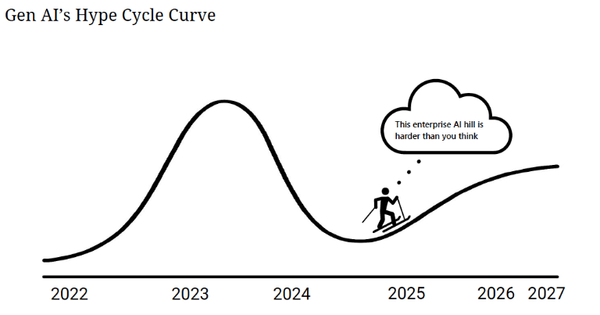
Technology shifts always take longer than expected. Cloud took more than ten years. AI will too—we’re maybe two years in.
Impact is always differentiated, never uniform. During cloud, ERP survived while generic productivity tools died. During AI, the same quality distinction will matter.
The questions for evaluating a software business haven’t changed: Does this business own proprietary data? Do workflows create real switching costs? Is it mission critical? Does value compound through network effects?
How we answer them almost certainly needs to. What data is proprietary when AI can synthesize public information at scale? What complex workflows are still protected and which ones can AI replicate? Are we enhancing humans with subject matter expertise or does our software enhance a labor pool that’s not really needed in the age of AI?
One of the great things about investing is being able to draw on lessons across history. The technology is always new. Mobile, cloud, AI, whatever comes next are always never before seen. But the questions these novel inventions surface, those are repeated across history. It’s how we answer them that matters.
Idea I’m Chasing
What decisions are being made today that will have unintended consequences tomorrow?
Ideas I’m Collecting
“We accept new information with delight instead of making comparisons to what we already believe; we are curious, not jaded.”- Rick Rubin, The Creative Act
“Great leaders challenge themselves and others to understand their businesses better and rethink them so that they can achieve two seemingly conflicting things at the same time.” - David Cote, Winning Now, Winning Later