Reading notes
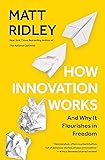
How Innovation Works
Matt Ridley
Highlights
Progress and innovation 26
Innovation, like evolution, is a process of constantly discovering ways of rearranging the world into forms that are unlikely to arise by chance – and that happen to be useful.
Serendipity plays a big part in innovation, which is why liberal economies, with their free-roving experimental opportunities, do so well. They give luck a chance. Innovation happens when people are free to think, experiment and speculate.
The chief way in which innovation changes our lives is by enabling people to work for each other. As I have argued before, the main theme of human history is that we become steadily more specialized in what we produce, and steadily more diversified in what we consume: we move away from precarious self-sufficiency to safer mutual interdependence.
There is confusion too about whose contribution among several candidates mattered most. And it was a gradual, stumbling change, with no eureka moment. These features are typical of innovation. The event I am talking about is the first controlled conversion of heat to work, the key breakthrough that made the Industrial Revolution possible if not inevitable and hence led to the prosperity of the modern world and the stupendous flowering of technology today.
Again and again, simultaneous invention marks the progress of technology as if there is something ripe about the moment.
My point is simple: Watt, brilliant inventor though he undoubtedly was, gets too much credit, and the collaborative efforts of many different people too little.
The truth is that twenty-one different people can lay claim to have independently designed or critically improved incandescent light bulbs by the end of the 1870s, mostly independent of each other, and that is not counting those who invented critical technologies that assisted in the manufacture of light bulbs, such as the Sprengel mercury vacuum pump.
The truth is that the story of the light bulb, far from illustrating the importance of the heroic inventor, turns out to tell the opposite story: of innovation as a gradual, incremental, collective yet inescapably inevitable process. The light bulb emerged inexorably from the combined technologies of the day. It was bound to appear when it did, given the progress of other technologies.
Edison’s approach worked: within six years he had registered 400 patents. He remained relentlessly focused on finding out what the world needed and then inventing ways of meeting the needs, rather than the other way around. The method of invention was always trial and error.
minute of work in 1880 on the average wage could earn you four minutes of light from a kerosene lamp; a minute of work in 1950 could earn you more than seven hours of light from an incandescent bulb; in 2000, 120 hours. Artificial light had come within the reach of ordinary people for the first time, banishing the gloom of winter, while expanding the opportunity to read and learn, plus incidentally reducing fire risk. There was no significant down-side to such innovation.
The problem is simply that nuclear power is a technology ill-suited to the most critical of innovation practices: learning by doing.
For a start, innovation is nearly always a gradual, not a sudden thing. Eureka moments are rare, possibly non-existent, and where they are celebrated it is with the help of big dollops of hindsight and long stretches of preparation, not to mention multiple wrong turns along the way.
Again and again in the history of innovation, it is the people who find ways to drive down the costs and simplify the product who make the biggest difference. The unexpected success of mobile telephony in the 1990s, which few saw coming, was caused not by any particular breakthrough in physics or technology, but by its sudden fall in price.
Every technology is a combination of other technologies; every idea a combination of other ideas.
He argued that ‘novel technologies arise by combination of existing technologies and that (therefore) existing technologies beget further technologies.’ I defy the reader to find a technological (as opposed to a natural) object in his or her pocket or bag that is not a combination of technologies and of ideas.
Recombination is the principal source of variation upon which natural selection draws when innovating biologically.
novelty. This explains too why innovation started in the first place. The burst of technology that began in dense populations exploiting rich, marine ecosystems in southern Africa more than 100,000 years ago was caused by the fact that – for whatever reason – people had begun exchanging and specializing in a way that Homo erectus and even Neanderthals never did.
Most inventors find that they need to keep ‘just trying’ things. Tolerance of error is therefore critical. It is notable that during the early years of a new technology – the railway, for example, or the internet – far more entrepreneurs went broke than made fortunes.
An element of playfulness probably helps, too. Innovators who just like playing around are more likely to find something unexpected.
Using examples like this, Edward Wasserman of the University of Iowa has made the case that most human innovations evolve through a process that looks awfully like natural selection, rather than are created by intelligent design.
The myth of the lonely inventor, the solitary genius, is hard to shake. Innovation always requires collaboration and sharing, as exemplified by the fact that even the simplest object or process is beyond the capacity of any one human being to understand.
One person may make a technological breakthrough, another work out how to manufacture it and a third how to make it cheap enough to catch on. All are part of the innovation process and none of them knows how to achieve the whole innovation.
The second paradox of the inevitability of invention is that it makes innovation look predictable, yet it is not. In retrospect, it is blindingly obvious that search engines would be the biggest and most profitable fruit of the internet. But did anybody see them coming? No.
Technology is absurdly predictable in retrospect, wholly unpredictable in prospect.
Amara’s Law states that people tend to overestimate the impact of a new technology in the short run, but to underestimate it in the long run.
Amara’s hype cycle explains a lot and it implies that, between the early disappointment and the later underestimate there must be a moment when we get it about right; I reckon these days it is fifteen years down the line. We expect too much of an innovation in the first ten years and too little in the first twenty, but get it about right looking fifteen years ahead. The explanation for this pattern surely lies in the fact that until the invention is turned into a practical, reliable, affordable innovation, over many years, its promise remains unfulfilled.
Other highlights 5
The resulting entities are the opposite of entropy: they are more ordered, less random, than their ingredients were before.
These two kinds of energy were separate: wood and coal did no mechanical work; wind, water and oxen did no warming.
‘In the short term, natural gas is an obvious bridge fuel to the “new” energy economy.’ But then it became clear that this cheap gas would mean the bridge was long, posing a threat to the viability of the renewable-energy industry. Self-interest demanded a retraction by Kennedy, which he duly provided, calling shale gas a ‘catastrophe’.
The paradox is that this is precisely what makes such achievements remarkable: there was a race to make them and somebody won. Individuals do not matter much in the long run, but that makes them all the more extraordinary in the short run. They emerge from among billions of rivals to find out, or make, something that any one of those billions could do.
Those who say that indefinite growth is impossible, or at least unsustainable, in a world of finite resources are therefore wrong, for a simple reason: growth can take place through doing more with less. Much ‘growth’ is actually shrinkage.
People, leadership, and culture 3
A steam engine proved to be ‘autocatalytic’: it drained the mines, which cut the cost of coal, which made the next machine cheaper and easier to make.
Thomas Edison understood better than anybody before, and many since, that innovation is itself a product, the manufacturing of which is a team effort requiring trial and error.
Worst of all, had governments waited a few more years, they would have found a far better replacement coming along that was even more frugal in energy and had none of the disadvantages: light-emitting diodes, or LEDs. The reign of the compact fluorescents lasted just six years before they too were rapidly abandoned and manufacturers stopped producing them because of the falling cost and rising quality of LEDs. It is as if the government in 1900 had forced people to buy steam cars instead of waiting for better internal-combustion vehicles. The whole compact fluorescent light bulb episode is an object lesson in misinnovation by government. As the economist Don Boudreaux put it: ‘Any legislation forcing Americans to switch from using one type of bulb to another is inevitably the product of a horrid mix of interest-group politics with reckless symbolism designed to placate an electorate that increasingly believes that the sky is falling.’
Time, focus, and practice 2
all told, than a blinding flash of inspiration, but vanity, vanity: people prefer to be thought brilliant rather than merely hard-working. Edison was also the one who made light bulbs (almost) reliable. Having hubristically claimed to have made a light bulb that would reliably last a long time before failing, he began a frantic search to prove his boast true. This is known today in Silicon Valley as ‘fake it till you make it’.
Most inventions lead to priority disputes between competing claimants. People seem to stumble on the same idea at the same time.
Customers and building businesses 1
This is not because the American economy is generating fewer products: it’s producing more. It is not because there is more recycling – though there is. It’s because of economies and efficiencies created by innovation. Take aluminium drinks cans. When first introduced in 1959 a standard aluminium can weighed 85 grams; today it weighs 13 grams, according to Professor Vaclav Smil. This has a counterintuitive implication: those who say growth is impossible without using more resources are simply wrong. It will always be possible to raise living standards further by lowering the amount of a resource that is used to produce a given output. Growth is therefore indefinitely ‘sustainable’.
Referenced by
Connect the public archive to find incoming links.