Move Fast and Break Nothing

“It’s fine if AI messes up an email, it’s a disaster if it causes a power outage.”
If you want to know why the adoption of AI will be slow within critical industries, that one sentence from a recent conversation I had sums it up pretty well.
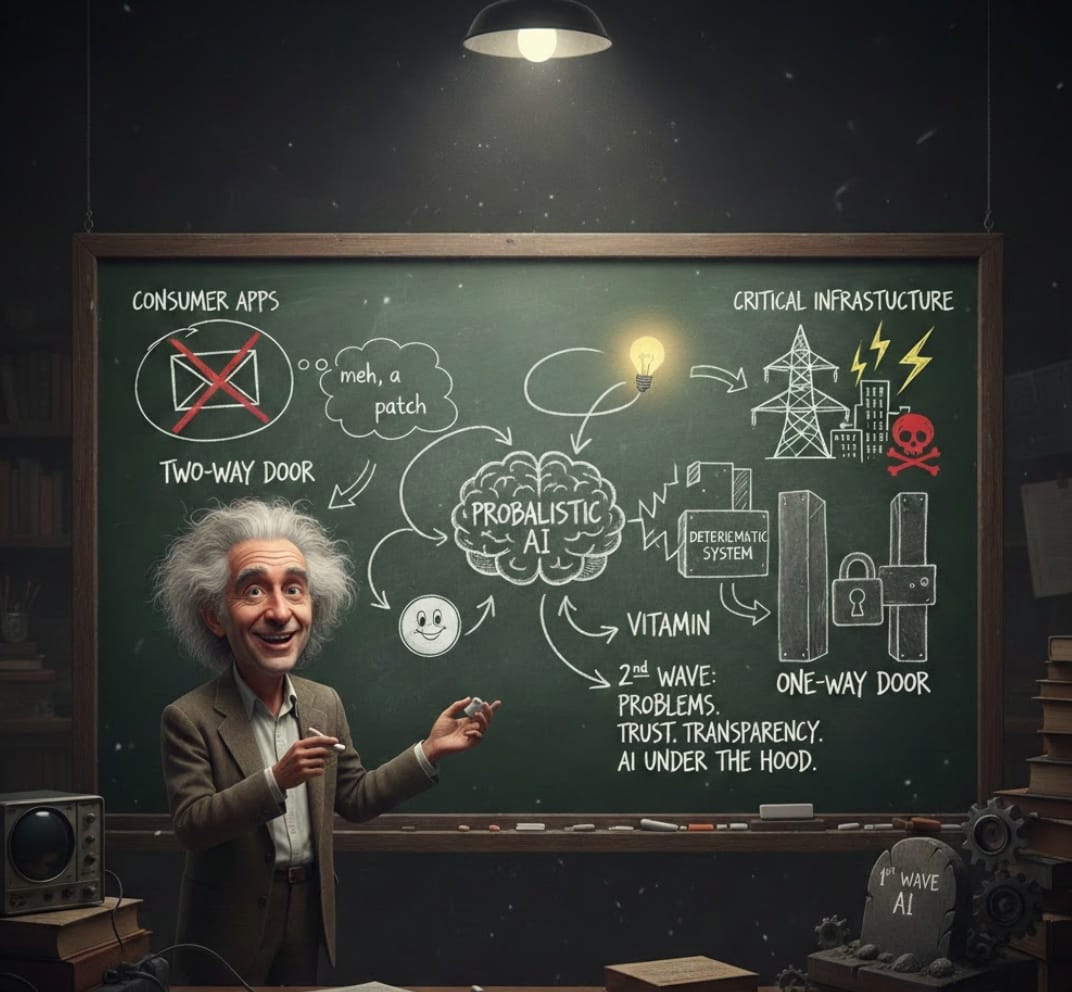
Generative AI runs on probabilistic thinking, using models to arrive at an answer of “best fit.” Critical infrastructure demands the opposite. It requires exact, deterministic outputs. And in these systems, risk multiplies. Being 10% off on an email creates embarrassment. Being 10% off on dispatching power creates blackouts and 1% difference in quality make a real difference.
This is largely why the first wave of AI in critical industries failed. It combined probabilistic thinking with a vitamin value prop in industries that need deterministic answers in real time. The first wave led with preventing failure - predicting outages, reducing downtime, avoiding costly repairs. Nice to have in theory, hard to prove in practice.
Selling counterfactuals is extremely difficult. They’re hard to measure, and when you add in the black box of AI, the value prop is opaque at best. Probabilistic vitamins in a deterministic world, the first wave of AI/ML is a graveyard of companies that led with this approach.
The first wave was AI’s adolescence in these industries and adolescence can’t be skipped. The second wave will be smarter for it.
In consumer apps, most decisions are two-way doors. You ship, you break things, you learn, you fix it. The cost of a bad decision is a few hundred thousand dollars and a patch.
In energy, almost every door is one-way. A wrong decision can’t be reversed once the grid goes down or a pipeline fails, and the cost is measured in millions, lawsuits, and regulatory scrutiny. Even if AI could improve operations by 30%, the fear of a single failure far outweighs the upside.
None of this means AI won’t transform these industries. It will. We’ve seen it happen already. Several of our portfolio companies use AI — both generative AI and predictive models. The ones that gained traction didn’t lead with the technology. They solved a specific problem while meeting the requirements that actually matter to these customers: security, usability, transparency. The AI was under the hood. The customer didn’t need to know or care.
I acknowledge that customers may care more now because most large organizations have some corporate wide goal to implement AI. After all, companies using AI or tied to it are seeing a stock bump. Show me the incentive and I’ll show you the outcome.
But speeding up real adoption in critical industries has always been about meeting these customers where they are. And where they are is an environment where security, transparency, and trust take precedent over just about all other buying criteria.
The companies that figure that out won’t need to sell AI at all. They’ll just be selling a better way to do the job.
Ideas I’m Chasing
Excellence and fairness aren’t mutually exclusive.
Bias hides when its impact is the largest.
Ideas I’m Collecting
The luckier you are the nicer you should be. - Morgan Housel
Being happy with what you have doesn’t prevent you from pursuing what you want. - Shane Parish