Vibe Thinking

Yes, I rolled my eyes at the title, too.
But stay with me here and acknowledge that I am thinking out loud.
Vibe coding took the world by storm over the last 12 months. It placed the power of software engineering in the hands of everyone. It changed how we write software by letting AI handle implementation while the engineer focuses on strategy and long-term-vision.
I'm starting to wonder if (and maybe when) that same shift applies to knowledge work.
This week, Anthropic launched Claude for Excel (yes, before Microsoft launched a Copilot specifically for Excel) and the early reviews are very positive.
Claude in Excel is now available on Pro plans.
— Claude (@claudeai) January 23, 2026
Claude now accepts multiple files via drag and drop, avoids overwriting your existing cells, and handles longer sessions with auto compaction.
Get started: https://t.co/cAMDXM1h7r pic.twitter.com/yt9Gy2HLY3
Just like engineers shifted from writing code to directing AI, finance professionals can now focus on what really matters—how accurate are my assumptions, how good is this team—instead of endless hours executing formulas and data entry.
This shift will reward multidisciplinary thinkers who can connect people and concepts across disciplines.
I've been focused on connecting concepts since I started investing, mostly inspired by psychology and statistics. Early on, my thinking was that if you don't have control of your own psychology or a grip on probability, no 'best practices' or 'true principles' will penetrate the story you've built for yourself.
It's why I take a ton of structured notes as I read and have them in a format where I can recall them easily.
With these tools, we can connect more concepts more quickly than ever before. Morgan Housel explained perfectly, as always, why this is important:
Being an expert in economics would help you understand the world if the world were governed purely by economics. But it’s not. It’s governed by economics, psychology, sociology, biology, physics, politics, physiology, ecology.
The same is true for every discipline. We could just as easily say energy is influenced by political science, economics, science, etc. and we'd do well to understand, at least a little, how they are all tied together.
Most people traditionally focused on executing because it's far easier to measure, but thinking is far more important. It's hard because thinking is not observable to the outside world.
Thinking looks like sleeping well, carving out large blocks of time without interruption, going on long walks, reading and writing a lot. It's already the most important thing you can do and that's only accelerating from here.
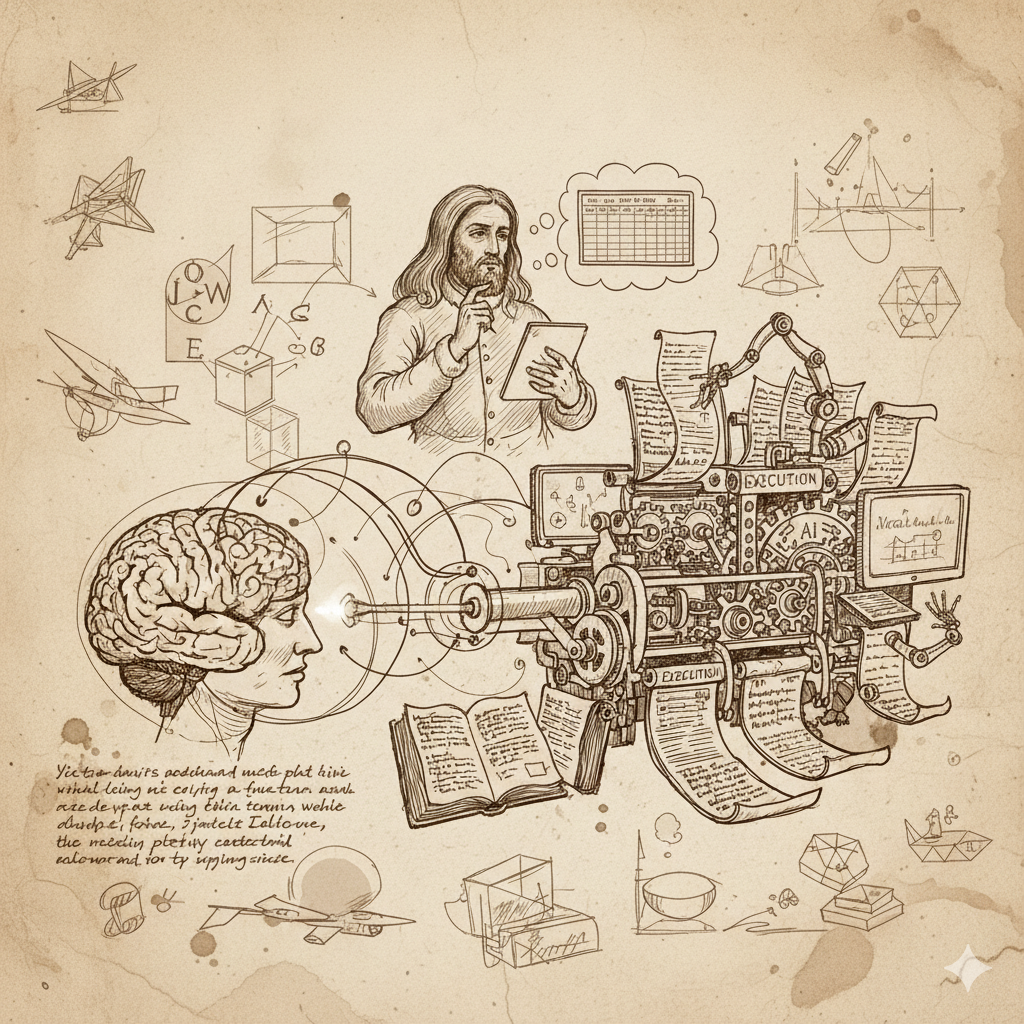
Execution only matters if you're thinking clearly. As AI handles more of the execution and analysis, we get more time to do the thinking that actually matters - the inputs that drive that execution.
We now have tools that let us put things into the world and learn if they're working faster than ever before. Want to test a design? AI ships three versions in hours. Need to model different scenarios? Claude builds them while you think through what each one would mean.
Execution never goes out of style, but it's becoming fast enough to be a thinking tool. You can iterate at the speed of your ideas.
Cheap execution means more experiments. More experiments mean faster learning. And faster learning compounds for people who can do three things: generate ideas by connecting concepts, interpret what the results mean, and iterate based on what they learned.
Analysis is getting cheaper and easier to access. What still requires real, patient investment? Two things: learning and relationships.
Learning - reading widely, connecting ideas across disciplines, staying curious. And people - cultivating relationships over years, building trust, creating the kind of reputation where people want you involved in their most exciting projects.
Both compound over time. And my bet is on those who invest in both. This is nothing new, it's always been the case, but I'm starting to wonder if these are the only advantages left at the end of the decade as other things get commoditized.
That looks like reading an article then plugging it into a custom Chief of Staff that knows your notes, emails, and calendar and asking it, "what else have I read that looks like this, who in my network would enjoy it, and what should I revisit because of this new data?"
That's vibe thinking. The ideas compound through better thinking. The relationships compound through trust. Both compound over time. And my bet is on people who've invested in both before AI made everything else cheap.
Ideas I'm Chasing
In trying to encourage rational behavior, don’t confine yourself to rational arguments.
Adolescence can’t be skipped.
Ideas I'm Collecting
“Systemic risk happens when you stop taking risks and get stuck with a system that no longer improves.” - The Anthology of Balaji
"Rigidity is fragility. Formlessness is unbreakable. We can choose one or the other." Ryan Holiday, Discipline Is Destiny