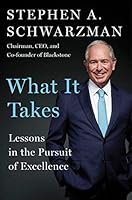
Reading notes
What It Takes
Stephen A. Schwarzman
Highlights
Time, focus, and practice 6
But I’ve always believed that it’s just as hard to achieve big goals as it is small ones. The only difference is that bigger goals have much more significant consequences. Since you can tackle only one personally defining effort at a time, it’s important to pursue a goal that is truly worthy of the focus it will require to ensure its success.
It also allowed me to refine my ability to simplify complex problems by focusing on only the two or three issues that will determine the outcome.
you want something badly enough, you can find a way. You can create it out of nothing. And before you know it, there it is. But wanting something isn’t enough. If you’re going to pursue difficult goals, you’re inevitably going to fall short sometimes. It’s one of the costs of ambition.
if you’re going to commit yourself to something, it’s as easy to do something big as it is to do something small. Both will consume your time and energy, so make sure your fantasy is worthy of your pursuit, with rewards commensurate to your effort.
Similarly, people who succeed in finance must start with repetitive practice before they can ever hope to achieve mastery.
just pay very close attention to what the other person is saying and the way he or she is saying it. If I can, I try to find some point of connection, an area of common ground, a shared interest or experience that turns a professional encounter into a more personal one. It sounds like common sense, but apparently in practice, it’s relatively rare.
Customers and building businesses 6
Once you succeed, people see only the success. If you fail, they see only the failure. Rarely do they see the turning points that could have taken you in a completely different direction. But it’s at these inflection points that the most important lessons in business and life are learned.
The lesson was that everything in business relates to everything else. For a business to succeed, each part has to work on its own and with all the other parts.
Getting to know Jack and watching him in action reinforced my growing belief that the most important asset in business is information. The more you know, the more perspectives you have and the more connections you can make, which allow you to anticipate issues.
I had reached an important conclusion about starting any business: it’s as hard to start and run a small business as it is to start a big one. You will suffer the same toll financially and psychologically as you bludgeon it into existence. It’s hard to raise the money and to find the right people. So if you’re going to dedicate your life to a business, which is the only way it will ever work, you should choose one with the potential to be huge.
The third and final way we thought about building our business was to keep challenging ourselves with an open-ended question: Why not? If we came across the right person to scale a business in a great investment class, why not? If we could apply our strengths, our network, and our resources to make that business a success, why not? Other firms, we felt, defined themselves too narrowly, limiting their ability to innovate. They were advisory firms, or investment firms, or credit firms, or real estate firms. Yet they were all pursuing financial opportunity.
Eights just do the stuff you tell them. Nines are great at executing and developing good strategies. You can build a winning firm with 9s. But people who are 10s sense problems, design solutions, and take the business in new directions without being told to do so. Tens always make it rain.
Learning and judgment 3
“The best executives are made, not born. They absorb information, study their own experiences, learn from their mistakes, and evolve.”
I learned to listen to people, pay attention to what they want and need even when they don’t say it, and be fearless when it comes to tackling difficult problems.
Teaching, I came to believe, is about more than sharing knowledge. You have to remove the obstacles in people’s way. In my case, the obstacle was the gap between my education up to that point and the education of my peers. That year, I went from failing to the dean’s list, at the top of my class.
People, leadership, and culture 2
Blackstone is a remarkable success because of our culture. We believe in meritocracy and excellence, openness and integrity.
From the outset, we strived to build a financial institution strong enough to survive multiple generations of owners and leadership. We did not want to be just another of those groups on Wall Street who set up a firm, make some money, fall out, and move on. We wanted to be spoken of in the same breath as the greatest names in our industry.
Progress and innovation 1
We are fixated on managing risk and never losing money. We are strong believers in innovation and growth—constantly asking questions in order to anticipate events so that we can evolve and change before we are forced to.
Other highlights 11
driven by a common mission to be the best in the world at whatever we choose to do. With a benchmark like that, it’s always easy to measure where we stand.
When people ask me how I succeed, my basic answer is always the same: I see a unique opportunity, and I go for it with everything I have. And I never give up.
At some point in life, we have to figure out who we are, he said. The sooner we do it the better, so we can pursue the opportunities that are right for us, not some false dream created by others.
Here was a world in which huge amounts of money were at stake, yet no one even bothered to train new people. They assumed we were smart enough to figure it out. That seemed like a crazy approach to me.
The Reserves reinforced my suspicion of hierarchy and my confidence in going against it if I saw something wrong.
No matter how successful, smart, or brave you are, you can always end up in a tough place.
As long as you can be honest and rational and are able to explain yourself, there is no reason to feel uncomfortable.
At a minimum, this includes the airport test: Would I want to be stuck waiting at the airport with you if our flight were delayed?
They established strong foundations for their careers by discovering that the smallest things matter and suffering the indignity of their early mistakes.
I didn’t just try selling whatever it was I had to sell. I listened. I waited to hear what people wanted, what was on their mind, then set about making it happen.
There is nothing more interesting to people than their own problems. If you can find out what they are and come up with solutions, they will want to talk to you no matter their rank or status.
Capital and investment decisions 4
In reality, this is all an exercise in evaluating their ability to deal with uncertainty. Finance, and investing especially, is a dynamic world in which you must adjust to new information, people, and situations quickly.
Investors are always looking for great investments. The easier you make it for them, the better for everyone.
In my relatively short career, I had learned that deals ultimately come down to a few key points that matter most to each side. If you can clear everything else away and focus on these points, you will be an effective negotiator. You cannot let all the voices, paperwork, and deadlines overwhelm you.
Even as the real estate market began to recover, investors still felt burned by the crash. We needed to come up with a sweetener, some incentive to calm their fears and help get them over their misunderstanding of the risk. In the same way I had used a sealed bid auction for CSX’s newspapers and pressured Harold Simmons with an endless flow of taxable yet unredeemable stock, we invented a novel structure designed to address a particular psychological state. It had to convey our confidence in the opportunity while giving investors a safety valve if they felt scared. We decided that for every three dollars an investor pledged to our real estate fund, two dollars could be discretionary. They could make a pledge, but if they didn’t like the specific deals we were presenting, they could hold back two-thirds of it.
Incentives and human behavior 1
It’s as easy to do something big as it is to do something small, so reach for a fantasy worthy of your pursuit, with rewards commensurate to your effort.
Referenced by
Connect the public archive to find incoming links.