Every Overbuild Ends the Same Way
I love reading financial history and business books. At some point I read that reading about the past is like reading about mistakes from others that we can hopefully dodge ourselves.
It's probably (definitely?) wishful thinking, but I'd rather be armed with the information than not.
I've read or re-read 4 books this year on this theme: 1873, 1929, House of Morgan, and right now I'm in the middle of re-reading Titan. Re-reading is an overlooked tactic because we are never living the exact same moment twice and that changes the perspective of what we read.
That happened to me this weekend with Titan and came across these lines:
Lured by easy profits, legions of investors rushed into a promising new field and when big gluts developed from over production they found it impossible to recoup their investment.
Low kerosene prices, a boon to consumers, were catastrophic for refiners. Rampant speculation had overbuilt the industry.
This type of overbuild happened in the railroad and oil industries in the late 1800s (71,000 miles of track were laid in the 1880s alone, and 89 of the country's 364 railroads went bankrupt in the Panic of 1873). In the last 40 years, it's happened at least 3 times:
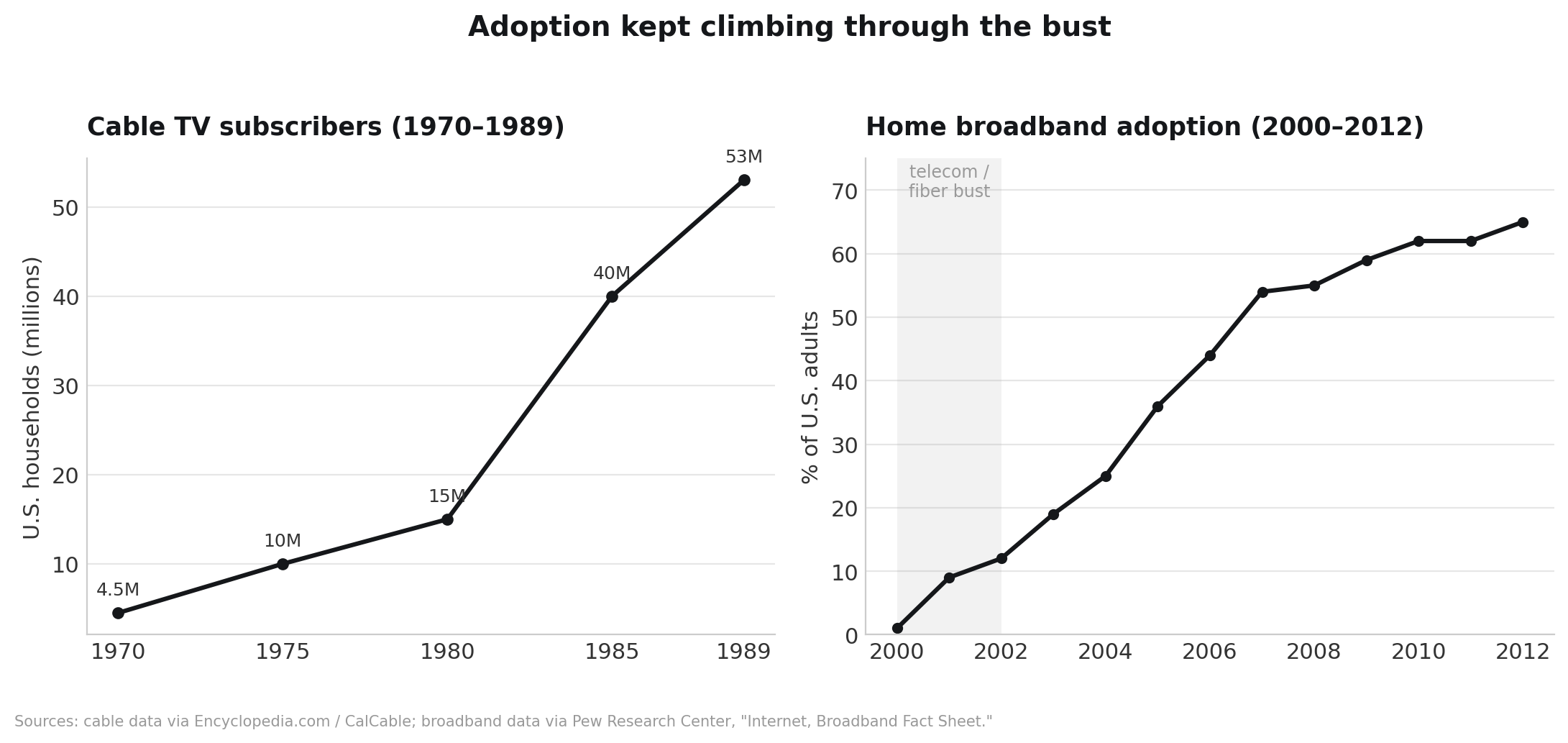
- Cable in the 1970s: subscribers grew from 4.5 million households in 1970 to 53 million by 1989, as systems multiplied and monthly rates came down.
- Telecom buried roughly 80 million miles of fiber and spent nearly $1 trillion, with only about a tenth of it lit by 2004. But home broadband adoption went from 1% of U.S. adults in 2000 to 65% by 2012, climbing straight through the bust
- Cleantech 1.0 saw VCs put over $25 billion into clean energy startups between 2006 and 2011 and lose more than half of it. At the same time, we got a huge natural gas build out from fracking, and Henry Hub prices fell from $8.86/MMBtu in 2008 to $2.75 by 2012. This combo helped keep electricity rates flat despite rising infrastructure costs.
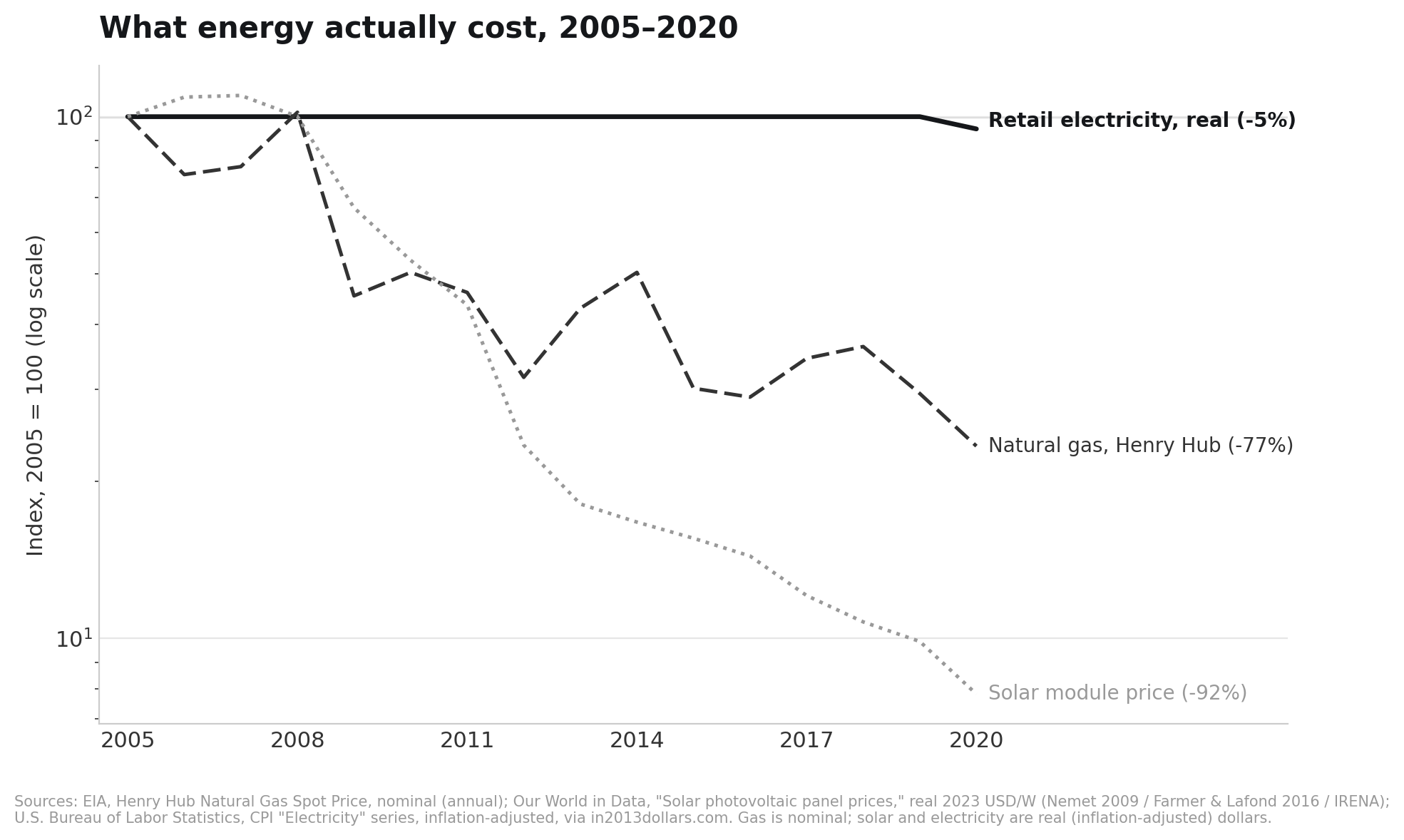
The constant with this type build out is that the customer always wins in the long run even if the economy busts in the short run. Our entertainment options grow, access to the internet becomes cheap. Energy tells the same story: from 2005 to 2020, solar module prices fell 92% and natural gas fell 77%, while retail electricity prices, adjusted for inflation, stayed essentially flat. In all of these cases, the marginal costs to serve another customer go to nearly zero - that's how progress happens.
It might be happening with AI now: the five biggest hyperscalers are on pace to spend over $600 billion on infrastructure in 2026 alone. The key difference here might be the demand that is still underserved.
Whatever happens with the AI buildout, I'd bet on the same pattern. The builders might not all survive it. But the customer wins, and so does whoever's positioned to invest in that.
Sources:
- Railroad mileage & Panic of 1873 bankruptcies: Wikipedia — List of railroad bankruptcies in North America; PBS American Experience — The Panic of 1873
- Cable TV subscribers, 4.5M (1970) to 53M (1989): Encyclopedia.com — Cable Television, History of; CalCable — History of Cable
- Fiber overbuild, ~80M miles / ~$1T spent, ~10% lit by 2004: The Timeless Investor — "They Buried a Trillion Dollars Underground"; TechnoStatecraft — Dark Fiber, an Archaeology of the Dot-Com Bubble
- Home broadband adoption, 1% (2000) to 65% (2012): Pew Research Center — Internet, Broadband Fact Sheet
- Cleantech 1.0, $25B+ invested 2006–2011, over half lost: MIT Energy Initiative — "Venture Capital and Cleantech" (2016 study)
- Henry Hub natural gas price, 2005–2020 annual, nominal, down 77%: EIA — Henry Hub Natural Gas Spot Price (Annual)
- Solar module price, 2005–2020, down 92% (real 2023 USD/watt): Our World in Data — Solar Photovoltaic Panel Prices (compiled from Nemet 2009, Farmer & Lafond 2016, and IRENA)
- U.S. retail electricity price, 2005–2020, inflation-adjusted, essentially flat (down ~5%): BLS CPI "Electricity" series via in2013dollars.com
- 2026 hyperscaler capex, $600B+ across top 5: Futurum Group — AI Capex 2026: The $690B Infrastructure Sprint; Yahoo Finance — Hyperscalers Hit $700 Billion in 2026 AI Spending Plans